Summarize This Guide with AI
The page title, key topics and source link are passed to your selected tool in a prepared prompt.
On this page
A penile prosthesis, also called a penile implant, is a medical device surgically placed inside the penis to provide mechanical rigidity for men with erectile dysfunction (ED). It is generally considered when other ED treatments have failed, cannot be used, are unacceptable, or when an informed patient prefers a definitive mechanical option. Penile implants can produce an erection mechanically, but they do not directly increase sexual desire, restore ejaculation after prostate surgery or function as a cosmetic penis-lengthening operation. Implant surgery also permanently alters the erectile tissue, so the decision requires detailed counselling about benefits, limitations, infection, mechanical failure and possible future revision.
What does “penile implant” mean?
In English-language medical care, penile prosthesis and penile implant refer to the same treatment category. The Turkish colloquial phrase mutluluk çubuğu is not an appropriate primary term for an international medical page because it can trivialise a surgical implant and its risks.
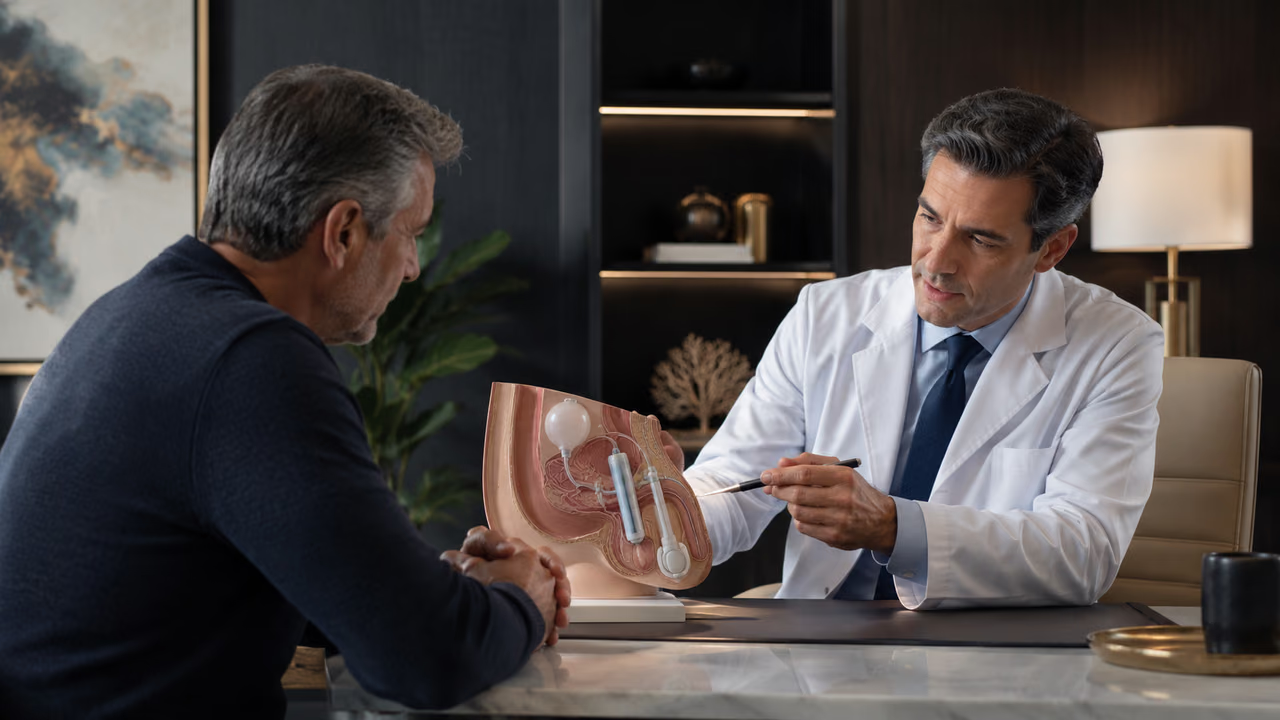
The device is placed inside the corpora cavernosa—the erectile cylinders of the penis. Depending on the system, rigidity is produced either by inflating cylinders with fluid or by positioning bendable semi-rigid rods.
How does a penile prosthesis work?
A prosthesis does not restore the original biological erection mechanism. Instead, it provides rigidity mechanically.
With an inflatable system, cylinders inside the penis are filled from a fluid reservoir using a pump usually placed in the scrotum. With a malleable system, the implanted rods remain firm enough for intercourse and are manually positioned up or down.
Because the implant acts mechanically, it can provide rigidity even when blood-vessel or nerve damage makes spontaneous erection unreliable.
When may a penile implant be considered?
Current EAU guidance recommends penile prosthesis implantation when other treatments fail or according to informed patient preference after discussion of benefits and harms.
Situations can include:
- severe or persistent ED with inadequate response to acceptable non-surgical options;
- inability to use oral ED medicines because of contraindications or side effects;
- poor response or unwillingness to continue injection or device-based treatments;
- ED after prostate or other pelvic treatment;
- selected men with Peyronie’s disease plus ED that does not respond to pharmacotherapy;
- a patient who understands alternatives but prefers an implanted mechanical solution.
This is a decision framework, not a checklist that automatically makes someone suitable. See when to consider a penile implant.
Is a penile implant always the final treatment after everything else?
Not necessarily. Modern ED guidance no longer treats every patient as having to progress through an identical three-step ladder. Some men may be unable or unwilling to use certain non-surgical options, while others prefer to continue them for years.
What matters is informed choice: the patient should understand realistic alternatives, why they may or may not fit his situation, and what implant surgery commits him to long term.
What types of penile implants are available?
Two broad categories are used: inflatable and malleable (semi-rigid) prostheses.
Inflatable penile prosthesis
The common three-piece inflatable system includes:
- paired cylinders inside the penis;
- a pump in the scrotum;
- a fluid reservoir placed elsewhere in the body, usually in the pelvis or abdominal wall region.
Squeezing the pump transfers fluid into the cylinders to create rigidity. A deflation mechanism returns the fluid to the reservoir.
Two-piece inflatable systems also exist and avoid a separate reservoir. They can be considered in selected anatomical or surgical circumstances.
Malleable or semi-rigid penile prosthesis
Malleable rods remain relatively firm all the time and are manually positioned for sexual activity and concealment. Their mechanism is simpler and they can be useful when hand dexterity, anatomy, previous abdominal surgery or patient preference makes an inflatable system less suitable.
Is one type universally better?
No. The EAU states that there is no demonstrated superiority among available implant types or surgical approaches in terms of efficacy and safety. Three-piece inflatable systems may be preferred by many patients because they more closely reproduce the change between a flaccid and rigid state, but preference is not proof that one device is medically superior for every patient.
Choice should take account of anatomy, prior surgery, manual dexterity, expectations and surgeon experience.
How is penile implant surgery planned?
Medical and sexual-function assessment
The diagnosis and severity of ED are reviewed, along with libido, orgasm, ejaculation, penile curvature, pain and previous ED treatments. The purpose is to confirm what the implant is expected to solve—and what it will not solve.
Infection and surgical-risk assessment
Active infection should be treated before elective implant surgery. Diabetes, smoking, immunosuppression, previous prosthetic infection, skin conditions, urinary symptoms and other medical risks may influence planning.
EAU evidence identifies diabetes as a risk factor for penile prosthesis infection, but also states that no randomised trial establishes one universal HbA1c threshold that defines whether surgery can proceed.
Device and expectation discussion
Before surgery, the patient should understand how the proposed implant works, how it will be operated, what the penis may feel like when deflated or positioned, and the possibility of future mechanical revision.
Is penile implant surgery reversible?
Not in the ordinary sense of returning to the pre-surgical anatomy. A device can be removed or replaced, but implantation requires surgical dilation and alteration of the corpora cavernosa. After explantation, spontaneous erectile function cannot be assumed to return to its previous state.
This is one reason counselling about alternatives and long-term expectations is essential before the first operation.
What is recovery like after surgery?
Recovery varies with the implant type, surgical technique, previous procedures and individual healing. Early care focuses on wound healing, swelling, pain control and identifying infection or device-related problems.
Inflatable implants also require later education on inflation and deflation once the surgeon considers healing adequate. Sexual use is resumed only after postoperative review and sufficient recovery; a universal timeline should not be promised in an editorial article because individual surgical plans differ.
What are the main risks?
Important risks include:
- infection;
- mechanical failure or device malfunction;
- pain or prolonged tenderness;
- bleeding or haematoma;
- erosion into surrounding tissues;
- urethral injury;
- reservoir-related injury with inflatable systems;
- tissue ischaemia in rare cases;
- dissatisfaction with size, feel, concealment or device handling;
- need for revision, replacement or removal.
Modern infection-prevention methods and coated devices have reduced infection rates in primary low-risk implantation, but the risk is not zero. Infection is especially important because it can require implant removal and further surgery.
Mechanical devices can also fail over time. No responsible counselling should describe an implant as a lifetime device that will never require revision.
Which symptoms require prompt postoperative assessment?
The surgical team should be contacted promptly for symptoms such as:
- increasing redness, warmth or wound drainage;
- fever or systemic illness;
- worsening swelling or severe pain;
- wound opening;
- visible or suspected device erosion;
- inability to urinate;
- a sudden device malfunction after activation;
- unusual skin colour or concern about blood supply.
Emergency care may be necessary if symptoms are severe or rapidly progressing.
Does a penile implant change sexual desire or sensation?
The implant’s direct function is rigidity. It does not create libido. If low sexual desire is caused by depression, endocrine disease, medication effects or relationship factors, those issues need separate assessment.
Penile sensation and orgasm may remain possible if the relevant nerves and sexual-response pathways are intact, but implant surgery does not determine a particular sensory or orgasmic outcome.
Does a penile implant affect ejaculation?
The implant itself does not produce semen or restore ejaculation. A man who no longer ejaculates after radical prostatectomy will not regain semen emission because a prosthesis was placed.
If ejaculation is intact before implant surgery and there is no separate condition affecting it, the prosthesis is not designed to stop ejaculation. Individual outcomes still depend on the person’s underlying disease and previous treatment.
Does a penile implant affect urination?
The device is placed in the erectile bodies, not the urinary channel. It is not intended to improve urinary flow or treat prostate enlargement. Urinary symptoms should be assessed separately, particularly before surgery because active urinary infection or unresolved obstruction can change surgical planning.
Does a penile implant make the penis longer?
A prosthesis is not a cosmetic lengthening operation. Many men with long-standing ED, Peyronie’s disease or previous pelvic surgery perceive penile shortening before implant surgery. The implant restores mechanical rigidity within the available corporal space; it should not be sold as a method for creating additional penile length.
Expectations about postoperative size should be discussed explicitly because dissatisfaction can occur when a patient assumes implantation will restore a previous or imagined length.
Is the implant visible from outside?
An implant is internal, but how noticeable it is can vary. Body habitus, device type, clothing, scrotal anatomy and the position of a malleable implant can affect concealment. With an inflatable system, the pump is in the scrotum and can be felt.
How long does a penile implant last?
Penile prostheses are designed for long-term use, but they are mechanical devices and can eventually fail. Published survival varies by device, follow-up duration and study. Rather than promising a fixed lifespan, counselling should prepare the patient for the possibility of future revision or replacement.
Professional education context
Apex Andrology Academy was founded by Dr. Cem Özlük MD., and penile prosthesis is among its physician-oriented education topics. This education relationship is separate from patient care and does not imply a treatment outcome.
This is an education/entity statement only. It does not establish an additional official specialty, accreditation, device superiority or superior patient outcomes.
Questions to ask before implant surgery
- Why is a penile implant being considered in my case?
- Which non-surgical options remain reasonable?
- What will the implant change, and what will it not change?
- Which device type is being proposed and why?
- How will I operate it?
- What factors increase my infection or revision risk?
- What should I expect regarding penile size and sensation?
- What happens if the device becomes infected or fails mechanically?
- How will postoperative training and long-term follow-up work?
Medical information note
A penile prosthesis is a surgical treatment for erectile rigidity, not a treatment for all aspects of sexual function. Implantation has important long-term consequences and should follow informed discussion of alternatives, risks, device use and the possibility of future revision.
PHYSICIAN EDUCATION
Related physician education
Dr. Cem Özlük MD. also provides physician education related to this field through Apex Andrology Academy.
Sources4 sources
2026
European Association of Urology. **EAU Guidelines on Sexual and Reproductive Health — Management of Erectile Dysfunction, penile prostheses section.** 20262025
European Association of Urology Patient Information. **Penile implants for erectile dysfunction.** Updated September 20252026
European Association of Urology. **EAU Guidelines on Sexual and Reproductive Health — Penile Curvature.** 20262026
European Association of Urology. **Sexual and Reproductive Health Guidelines — Appendix 3: Penile prostheses models.** 2026